 a2ccb6e317
|
||
|---|---|---|
| dist/fastapi-0.1.0 | ||
| docs | ||
| fastapi | ||
| scripts | ||
| tests | ||
| .gitignore | ||
| .travis.yml | ||
| LICENSE | ||
| Pipfile | ||
| Pipfile.lock | ||
| README.md | ||
| mkdocs.yml | ||
| mypy.ini | ||
| pyproject.toml | ||
| requirements.txt | ||
README.md
FastAPI framework, high performance, easy to learn, fast to code, ready for production



Documentation: https://fastapi.tiangolo.com
FastAPI is a modern, fast (high-performance), web framework for building APIs with Python 3.6+.
The key features are:
- Fast: Very high performance, on par with NodeJS and Go (thanks to Starlette and Pydantic).
- Intuitive: Great editor support. Completion everywhere. Less time debugging.
- Easy: Designed to be easy to use and learn. Less time reading docs.
- Short: Minimize code duplication. Multiple features from each parameter declaration.
- Robust: Get production-ready code. With automatic interactive documentation.
- Standards-based: Based on (and fully compatible with) the open standards for APIs: OpenAPI and JSON Schema.
Requirements
Python 3.6+
FastAPI stands on the shoulders of giants:
Installation
$ pip3 install fastapi
You will also need an ASGI server, for production such as uvicorn.
$ pip3 install uvicorn
Example
- Create a file
main.pywith:
from fastapi import FastAPI

app = FastAPI()

@app.get('/')
async def read_root():
    return {'hello': 'world'}
- Run the server with:
uvicorn main:app --debug
Note: the command uvicorn main:app refers to:
main: the filemain.py(the Python "module").app: the object created inside ofmain.pywith the lineapp = FastAPI().--debug: make the server restart after code changes. Only use for development.
Check it
Open your browser at http://127.0.0.1:8000.
You will see the JSON response as:
{"hello": "world"}
Interactive API docs
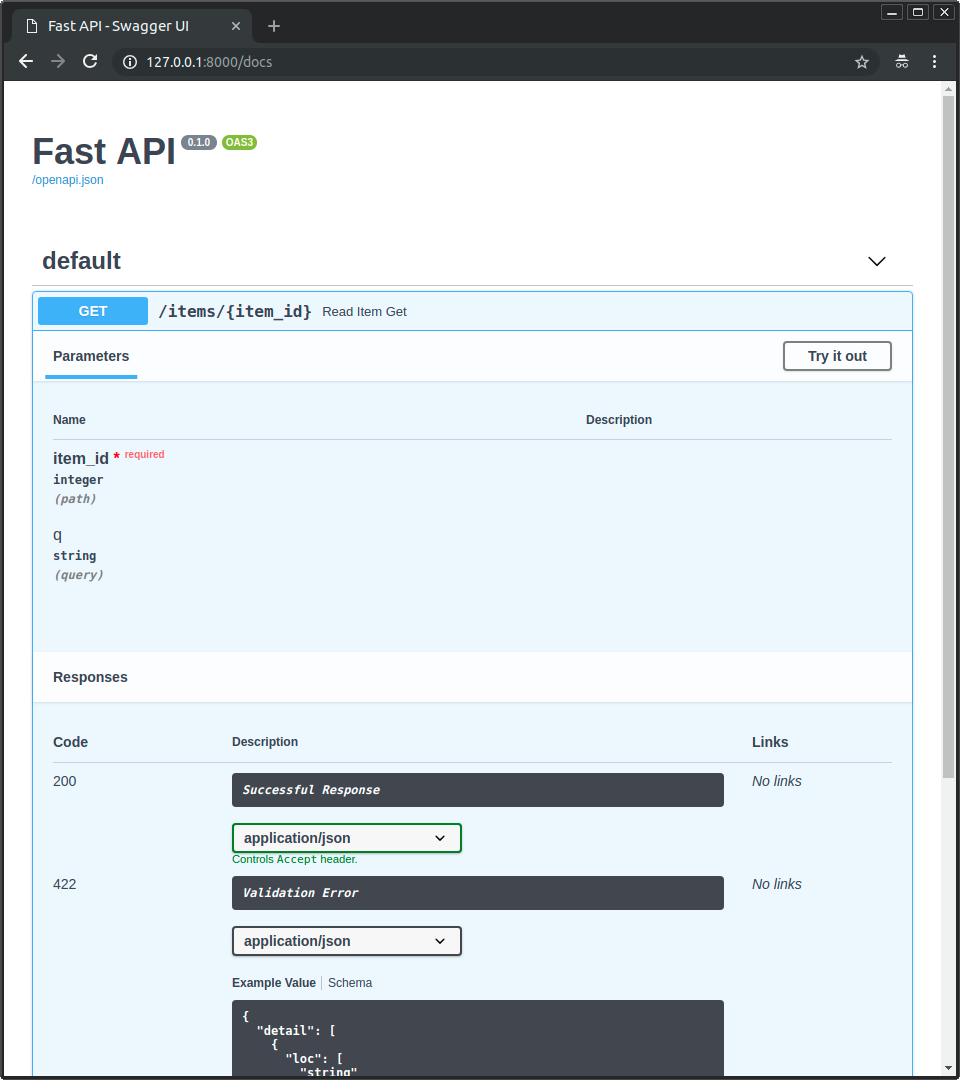
Now go to http://127.0.0.1:8000/docs.
You will see the automatic interactive API documentation (provided by Swagger UI):
Alternative API docs
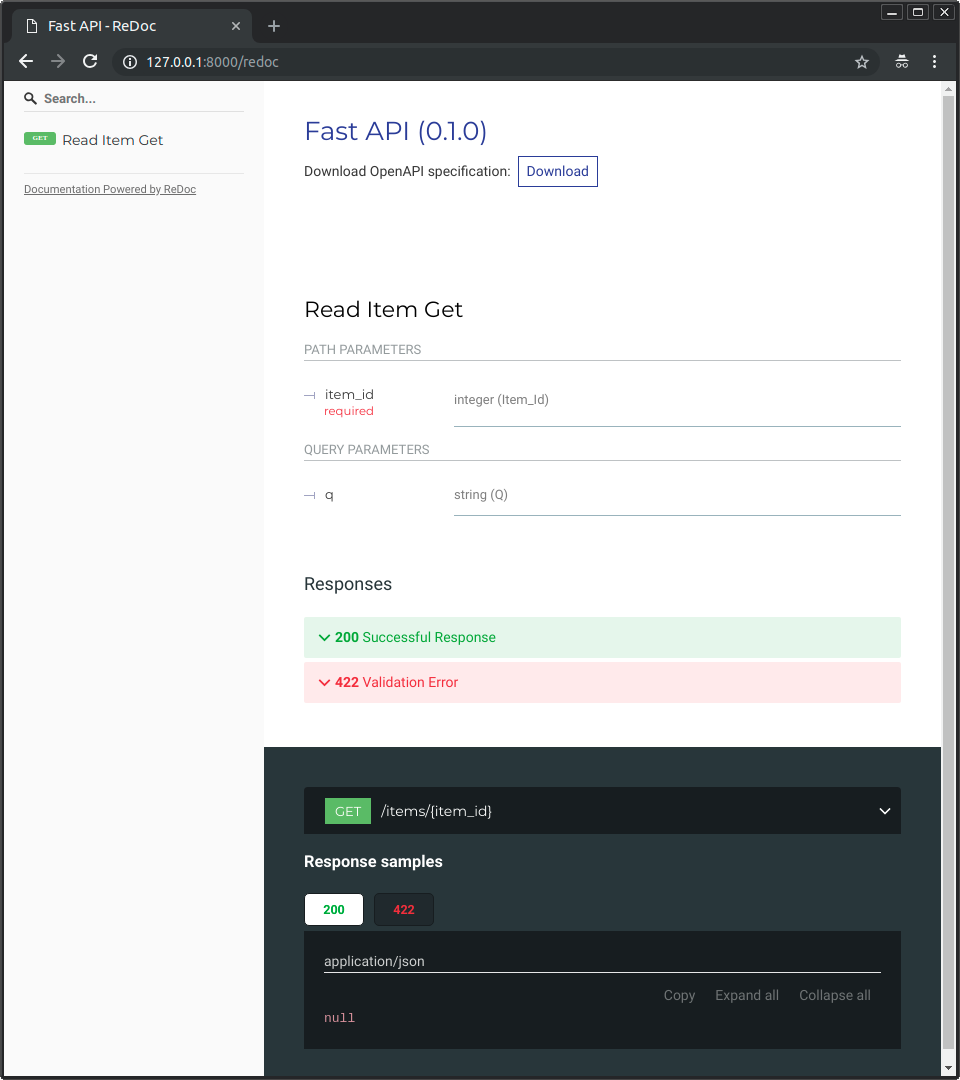
And now, go to http://127.0.0.1:8000/redoc.
You will see the alternative automatic documentation (provided by ReDoc):
Example upgrade
Now modify the file main.py to include:
- a path parameter
item_id. - a body, declared using standard Python types (thanks to Pydantic).
- an optional query parameter
q.
from fastapi import FastAPI
from pydantic import BaseModel

app = FastAPI()


class Item(BaseModel):
    name: str
    price: float
    is_offer: bool = None


@app.get('/')
async def read_root():
    return {'hello': 'world'}


@app.post('/items/{item_id}')
async def create_item(item_id: int, item: Item, q: str = None):
    return {"item_name": item.name, "item_id": item_id, "query": q}
The server should reload automatically (because you added --debug to the uvicorn command above).
Interactive API docs upgrade
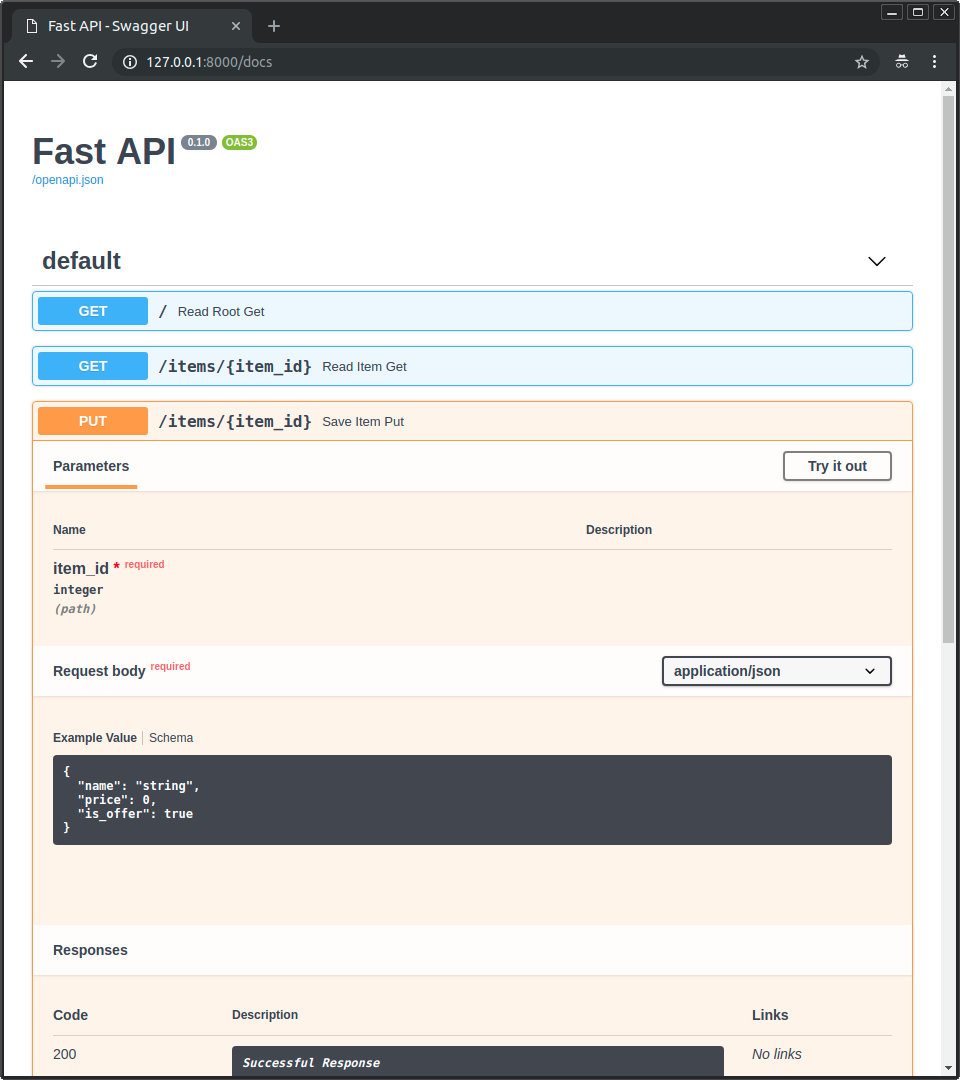
Now go to http://127.0.0.1:8000/docs.
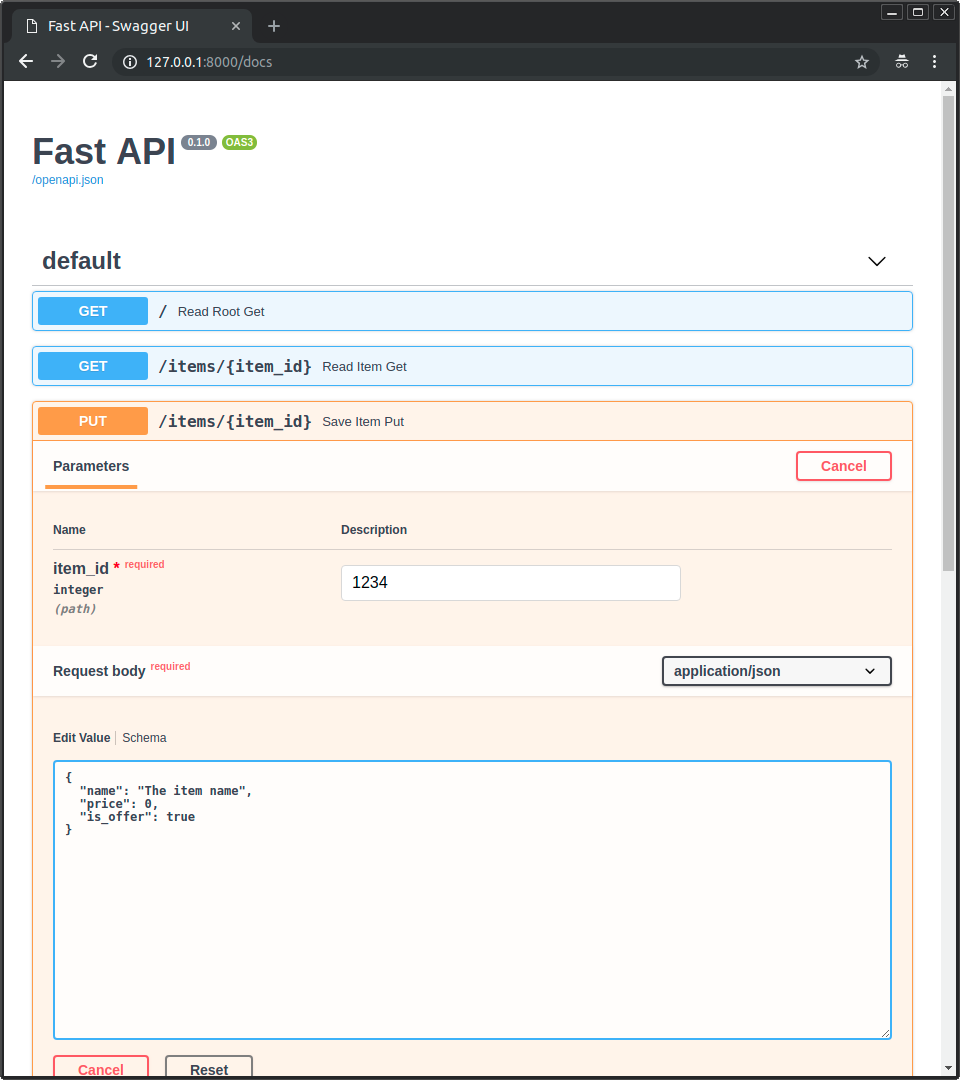
- The interactive API documentation will be automatically updated, including the new query, and body:
- Click on the button "Try it out", it allows you to fill the parameters and directly interact with the API:
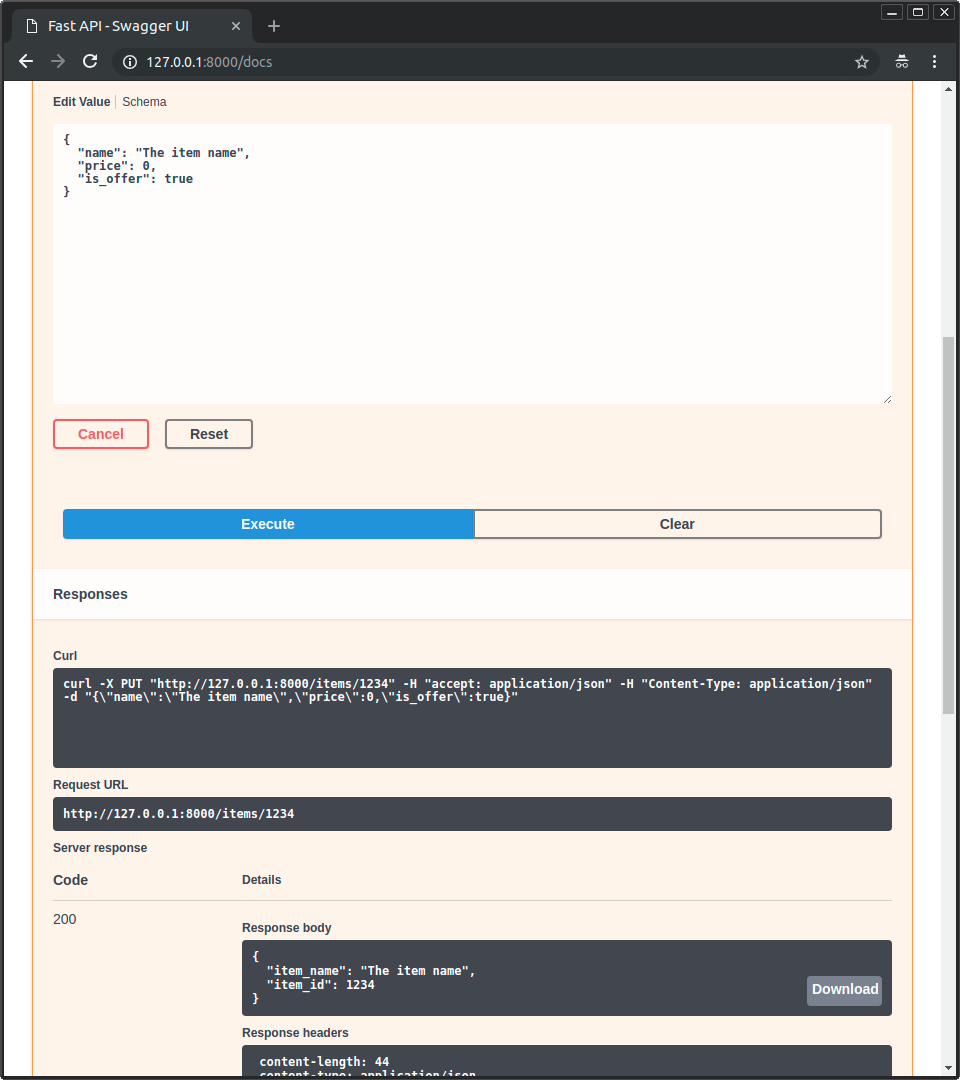
- Then click on the "Execute" button, the user interface will communicate with your API, send the parameters, get the results and show them on the screen:
Alternative API docs upgrade
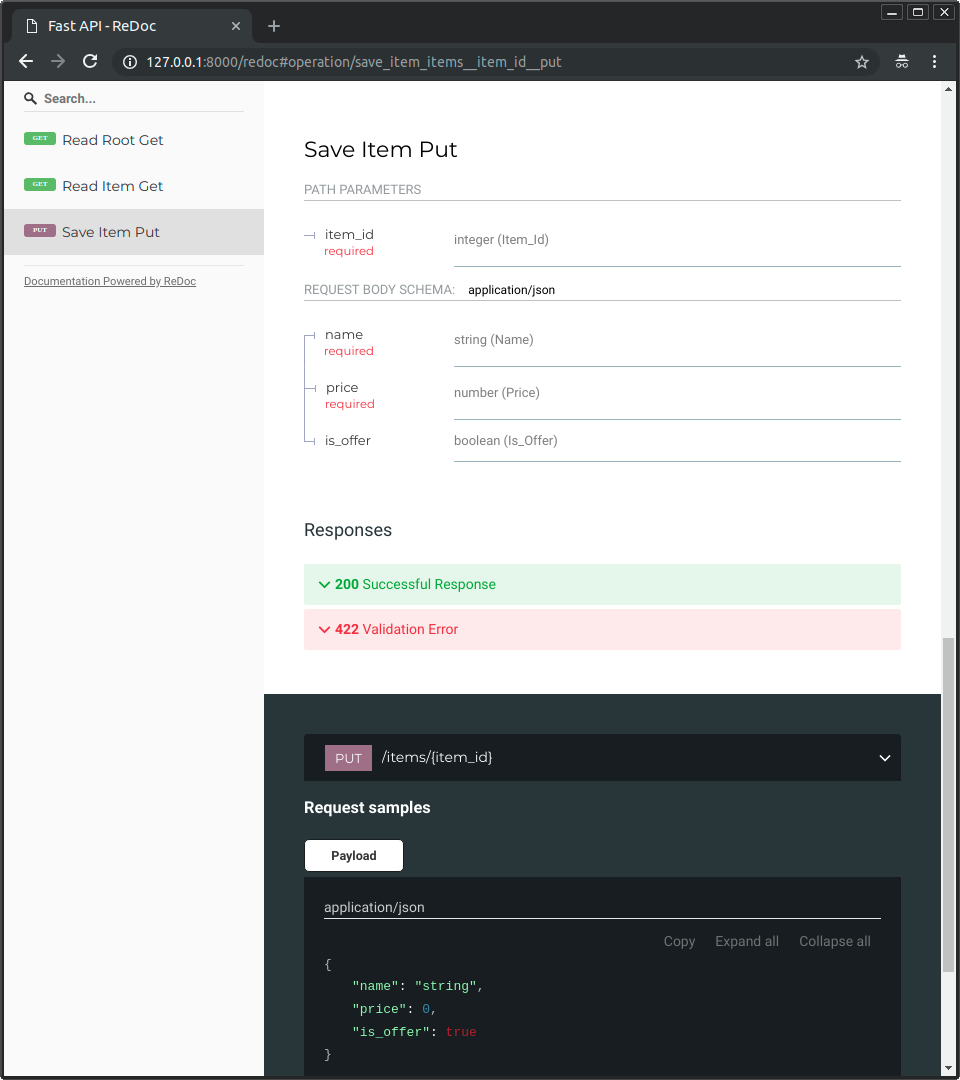
And now, go to http://127.0.0.1:8000/redoc.
- The alternative documentation will also reflect the new query parameter and body:
Recap
In summary, you declare once the types of parameters, body, etc. as function parameters. You don't have to learn a new syntax, use a specific library, class or object to declare fields, you just type standard Python types.
For example, for an int:
item_id: int
or for a more complex Item model:
item: Item
...and with that single declaration you get:
- Editor support, including:
- Completion.
- Type checks.
- Validation of data:
- Automatic and clear errors when the data is invalid.
- Validation even for deeply nested JSON objects.
- Serialization of input data: from the network to Python, reading from:
- JSON.
- Forms.
- Files.
- Path parameters.
- Query parameters.
- Cookies.
- Headers.
- Serialization of output data: from Python to network (as JSON):
- Convert Python types (
str,int,float,bool,list, etc). datetimeobjects.UUIDobjects.- Database models.
- ...and many more.
- Convert Python types (
- Automatic interactive API documentation, including 2 alternative user interfaces:
- Swagger UI.
- ReDoc.
Coming back to the previous code example, FastAPI will:
- Validate that there is an
item_idin the path. - Validate that the
item_idis of typeint. If it is not, the client will see a useful error. - Check if there is an optional query parameter named
q(as inhttp://127.0.0.1:8000/items/foo?q=somequery). As theqparameter is declared with= None, it is optional. Without theNoneit would be required (as is the body). - Read the body as JSON:
- Check that it has a required attribute
namethat should be astr. - Check that is has a required attribute
pricethat has to be afloat. - Check that it has an optional attribute
is_offer, that should be abool, if present. - All this would also work for deeply nested JSON objects
- Check that it has a required attribute
- Convert from and to JSON automatically.
- Document everything as OpenAPI, so the interactive documentation is created and updated automatically.
- Provide the interactive documentation web interfaces.
We just scratched the surface, but you already get the idea of how it all works.
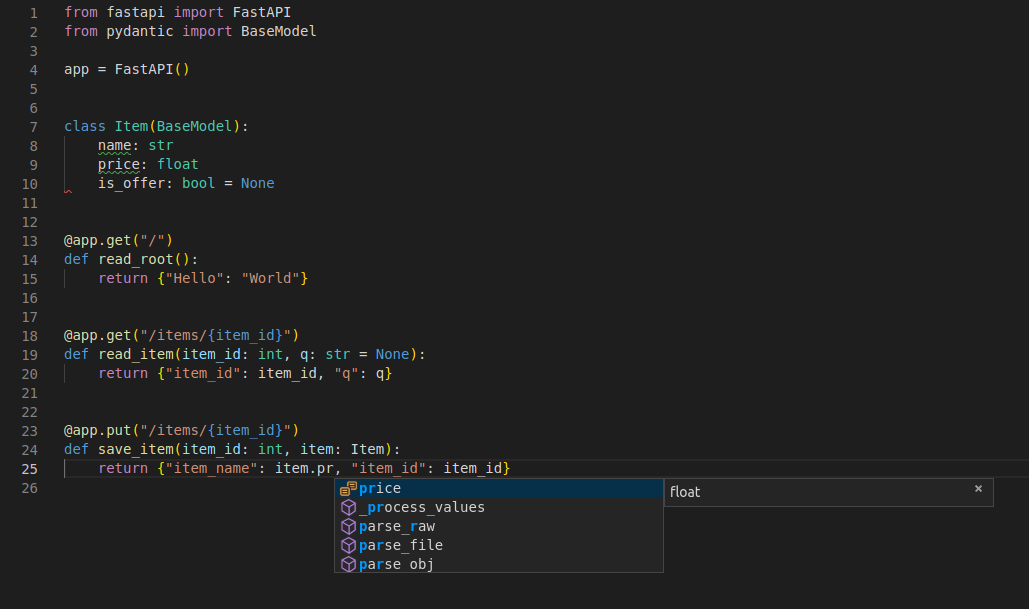
Try changing the line with:
return {"item_name": item.name, "item_id": item_id, "query": q}
...from:
... "item_name": item.name ...
...to:
... "item_price": item.price ...
...and see how your editor will auto-complete the attributes and know their types:
For a more complete example including more features, see the tutorial.
Spoiler alert: the tutorial, although very short, includes:
- Declaration of parameters from different places as: headers, cookies, form data and files.
- How to set validation constrains as
maximum_lengthorregex. - A very powerful and easy to use Dependency Injection system (also known as "components", "resources", "providers", "services").
- Security and authentication, including support for OAuth2 with JWT tokens and HTTP Basic auth.
- More advanced (but equally easy) techniques for declaring deeply nested models (JSON body, Form and Files) (thanks to Pydantic).
- Many extra features (thanks to Starlette) as WebSockets, GraphQL, extremely easy tests based on
requestsandpytest, CORS, Cookie Sessions and more.
Optional Dependencies
Used by Pydantic:
ujson- for faster JSON parsing.email_validator- for email validation.
Used by Starlette:
requests- Required if you want to use theTestClient.aiofiles- Required if you want to useFileResponseorStaticFiles.jinja2- Required if you want to use the default template configuration.python-multipart- Required if you want to support form parsing, withrequest.form().itsdangerous- Required forSessionMiddlewaresupport.pyyaml- Required forSchemaGeneratorsupport.graphene- Required forGraphQLAppsupport.ujson- Required if you want to useUJSONResponse.
You can install all of these with pip3 install fastapi[full].
License
This project is licensed under the terms of the MIT license.