# FastAPI { #fastapi }

FastAPI framework, high performance, easy to learn, fast to code, ready for production




---
**Documentation**: [https://fastapi.tiangolo.com](https://fastapi.tiangolo.com)
**Source Code**: [https://github.com/fastapi/fastapi](https://github.com/fastapi/fastapi)
---
FastAPI is a modern, fast (high-performance), web framework for building APIs with Python based on standard Python type hints.
The key features are:
* **Fast**: Very high performance, on par with **NodeJS** and **Go** (thanks to Starlette and Pydantic). [One of the fastest Python frameworks available](#performance).
* **Fast to code**: Increase the speed to develop features by about 200% to 300%. *
* **Fewer bugs**: Reduce about 40% of human (developer) induced errors. *
* **Intuitive**: Great editor support. Completion everywhere. Less time debugging.
* **Easy**: Designed to be easy to use and learn. Less time reading docs.
* **Short**: Minimize code duplication. Multiple features from each parameter declaration. Fewer bugs.
* **Robust**: Get production-ready code. With automatic interactive documentation.
* **Standards-based**: Based on (and fully compatible with) the open standards for APIs: [OpenAPI](https://github.com/OAI/OpenAPI-Specification) (previously known as Swagger) and [JSON Schema](https://json-schema.org/).
* estimation based on tests conducted by an internal development team, building production applications.
## Sponsors { #sponsors }
### Keystone Sponsor { #keystone-sponsor }
{% for sponsor in sponsors.keystone -%}
 {% endfor -%}
### Gold and Silver Sponsors { #gold-and-silver-sponsors }
{% for sponsor in sponsors.gold -%}
{% endfor -%}
{%- for sponsor in sponsors.silver -%}
{% endfor %}
[Other sponsors](https://fastapi.tiangolo.com/fastapi-people/#sponsors)
## Opinions { #opinions }
"_[...] I'm using **FastAPI** a ton these days. [...] I'm actually planning to use it for all of my team's **ML services at Microsoft**. Some of them are getting integrated into the core **Windows** product and some **Office** products._"
{% endfor -%}
### Gold and Silver Sponsors { #gold-and-silver-sponsors }
{% for sponsor in sponsors.gold -%}
{% endfor -%}
{%- for sponsor in sponsors.silver -%}
{% endfor %}
[Other sponsors](https://fastapi.tiangolo.com/fastapi-people/#sponsors)
## Opinions { #opinions }
"_[...] I'm using **FastAPI** a ton these days. [...] I'm actually planning to use it for all of my team's **ML services at Microsoft**. Some of them are getting integrated into the core **Windows** product and some **Office** products._"
Kabir Khan -
Microsoft (ref)Piero Molino, Yaroslav Dudin, and Sai Sumanth Miryala -
Uber (ref)Kevin Glisson, Marc Vilanova, Forest Monsen -
Netflix (ref)Brian Okken -
[Python Bytes](https://pythonbytes.fm/episodes/show/123/time-to-right-the-py-wrongs?time_in_sec=855) podcast host (ref)Timothy Crosley -
[Hug](https://github.com/hugapi/hug) creator (ref)Ines Montani - Matthew Honnibal -
[Explosion AI](https://explosion.ai) founders - [spaCy](https://spacy.io) creators (ref) -
(ref)Deon Pillsbury -
Cisco (ref) ## **Typer**, the FastAPI of CLIs { #typer-the-fastapi-of-clis }
 If you are building a CLI app to be used in the terminal instead of a web API, check out [**Typer**](https://typer.tiangolo.com/).
**Typer** is FastAPI's little sibling. And it's intended to be the **FastAPI of CLIs**. ⌨️ 🚀
## Requirements { #requirements }
FastAPI stands on the shoulders of giants:
* [Starlette](https://www.starlette.dev/) for the web parts.
* [Pydantic](https://docs.pydantic.dev/) for the data parts.
## Installation { #installation }
Create and activate a [virtual environment](https://fastapi.tiangolo.com/virtual-environments/) and then install FastAPI:
If you are building a CLI app to be used in the terminal instead of a web API, check out [**Typer**](https://typer.tiangolo.com/).
**Typer** is FastAPI's little sibling. And it's intended to be the **FastAPI of CLIs**. ⌨️ 🚀
## Requirements { #requirements }
FastAPI stands on the shoulders of giants:
* [Starlette](https://www.starlette.dev/) for the web parts.
* [Pydantic](https://docs.pydantic.dev/) for the data parts.
## Installation { #installation }
Create and activate a [virtual environment](https://fastapi.tiangolo.com/virtual-environments/) and then install FastAPI:
```console
$ pip install "fastapi[standard]"
---> 100%
```
**Note**: Make sure you put `"fastapi[standard]"` in quotes to ensure it works in all terminals.
## Example { #example }
### Create it { #create-it }
Create a file `main.py` with:
```Python
from fastapi import FastAPI
app = FastAPI()
@app.get("/")
def read_root():
return {"Hello": "World"}
@app.get("/items/{item_id}")
def read_item(item_id: int, q: str | None = None):
return {"item_id": item_id, "q": q}
```
Or use async def...
If your code uses `async` / `await`, use `async def`:
```Python hl_lines="7 12"
from fastapi import FastAPI
app = FastAPI()
@app.get("/")
async def read_root():
return {"Hello": "World"}
@app.get("/items/{item_id}")
async def read_item(item_id: int, q: str | None = None):
return {"item_id": item_id, "q": q}
```
**Note**:
If you don't know, check the _"In a hurry?"_ section about [`async` and `await` in the docs](https://fastapi.tiangolo.com/async/#in-a-hurry).
### Run it { #run-it }
Run the server with:
```console
$ fastapi dev
╭────────── FastAPI CLI - Development mode ───────────╮
│ │
│ Serving at: http://127.0.0.1:8000 │
│ │
│ API docs: http://127.0.0.1:8000/docs │
│ │
│ Running in development mode, for production use: │
│ │
│ fastapi run │
│ │
╰─────────────────────────────────────────────────────╯
INFO: Will watch for changes in these directories: ['/home/user/code/awesomeapp']
INFO: Uvicorn running on http://127.0.0.1:8000 (Press CTRL+C to quit)
INFO: Started reloader process [2248755] using WatchFiles
INFO: Started server process [2248757]
INFO: Waiting for application startup.
INFO: Application startup complete.
```
About the command fastapi dev...
The command `fastapi dev` reads your `main.py` file automatically, detects the **FastAPI** app in it, and starts a server using [Uvicorn](https://www.uvicorn.dev).
By default, `fastapi dev` will start with auto-reload enabled for local development.
You can read more about it in the [FastAPI CLI docs](https://fastapi.tiangolo.com/fastapi-cli/).
### Check it { #check-it }
Open your browser at [http://127.0.0.1:8000/items/5?q=somequery](http://127.0.0.1:8000/items/5?q=somequery).
You will see the JSON response as:
```JSON
{"item_id": 5, "q": "somequery"}
```
You already created an API that:
* Receives HTTP requests in the _paths_ `/` and `/items/{item_id}`.
* Both _paths_ take `GET` operations (also known as HTTP _methods_).
* The _path_ `/items/{item_id}` has a _path parameter_ `item_id` that should be an `int`.
* The _path_ `/items/{item_id}` has an optional `str` _query parameter_ `q`.
### Interactive API docs { #interactive-api-docs }
Now go to [http://127.0.0.1:8000/docs](http://127.0.0.1:8000/docs).
You will see the automatic interactive API documentation (provided by [Swagger UI](https://github.com/swagger-api/swagger-ui)):

### Alternative API docs { #alternative-api-docs }
And now, go to [http://127.0.0.1:8000/redoc](http://127.0.0.1:8000/redoc).
You will see the alternative automatic documentation (provided by [ReDoc](https://github.com/Rebilly/ReDoc)):

## Example upgrade { #example-upgrade }
Now modify the file `main.py` to receive a body from a `PUT` request.
Declare the body using standard Python types, thanks to Pydantic.
```Python hl_lines="2 7-10 23-25"
from fastapi import FastAPI
from pydantic import BaseModel
app = FastAPI()
class Item(BaseModel):
name: str
price: float
is_offer: bool | None = None
@app.get("/")
def read_root():
return {"Hello": "World"}
@app.get("/items/{item_id}")
def read_item(item_id: int, q: str | None = None):
return {"item_id": item_id, "q": q}
@app.put("/items/{item_id}")
def update_item(item_id: int, item: Item):
return {"item_name": item.name, "item_id": item_id}
```
The `fastapi dev` server should reload automatically.
### Interactive API docs upgrade { #interactive-api-docs-upgrade }
Now go to [http://127.0.0.1:8000/docs](http://127.0.0.1:8000/docs).
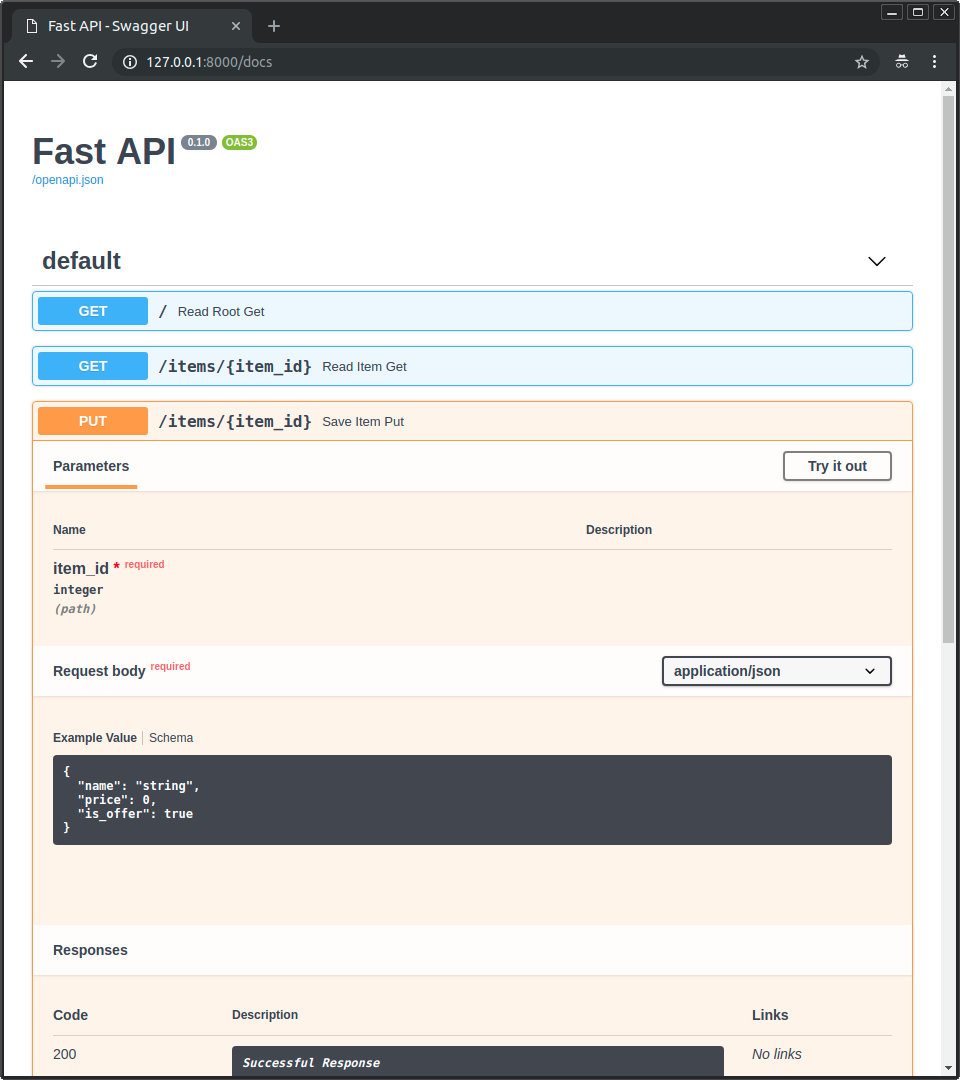
* The interactive API documentation will be automatically updated, including the new body:
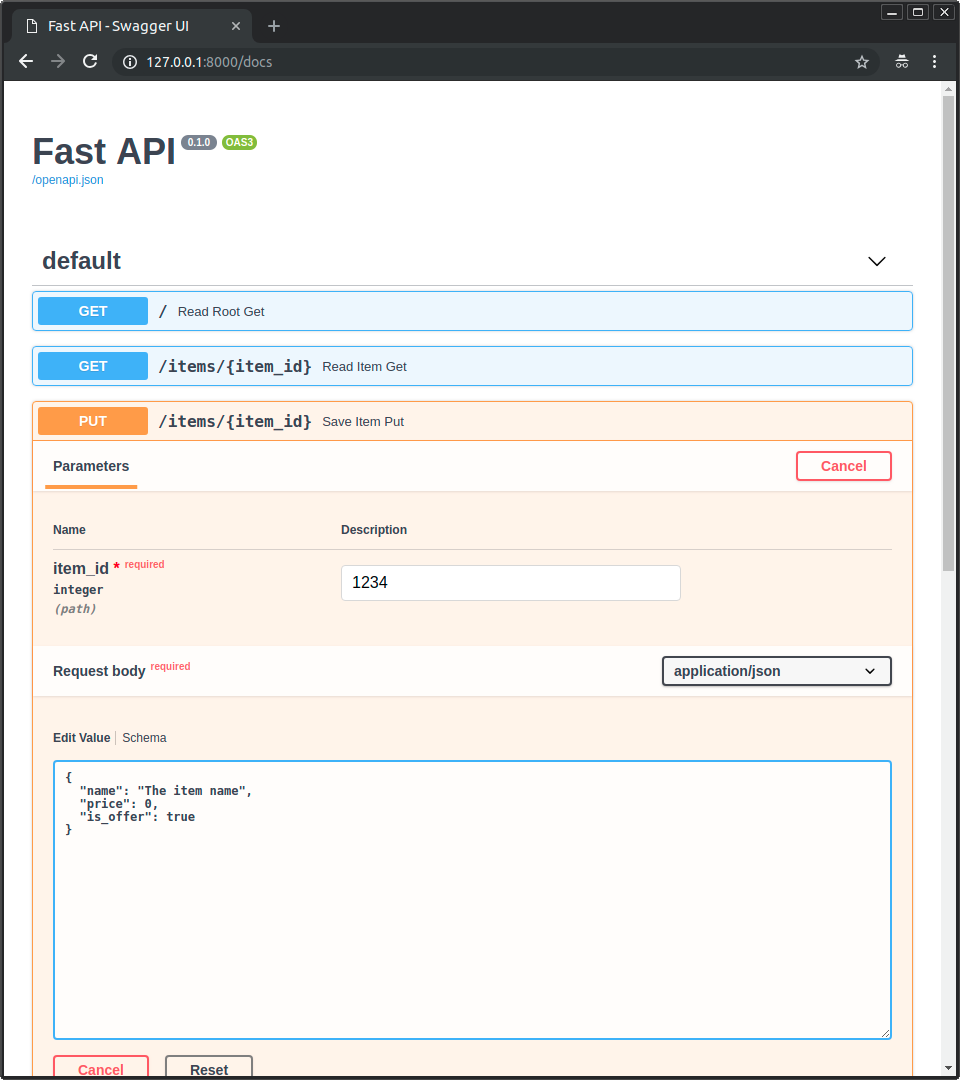
* Click on the button "Try it out", it allows you to fill the parameters and directly interact with the API:
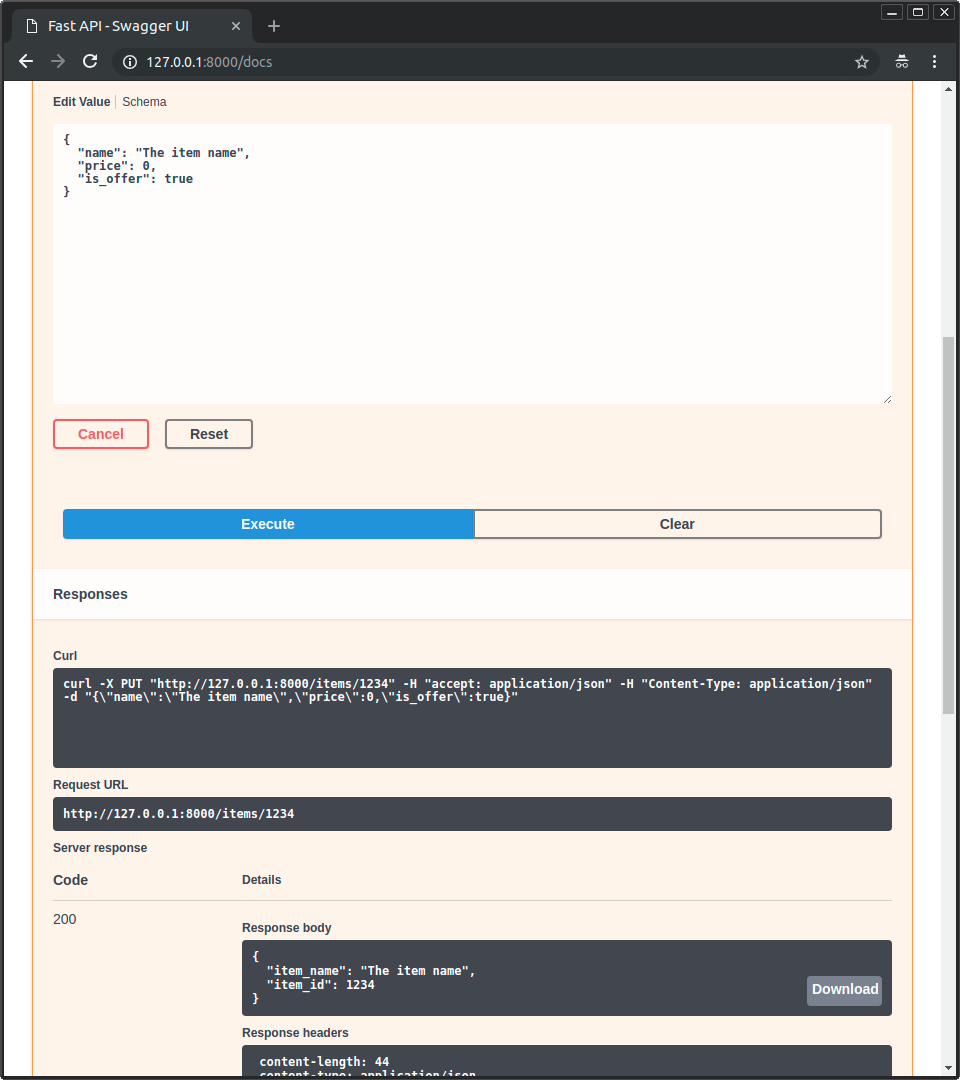
* Then click on the "Execute" button, the user interface will communicate with your API, send the parameters, get the results and show them on the screen:
### Alternative API docs upgrade { #alternative-api-docs-upgrade }
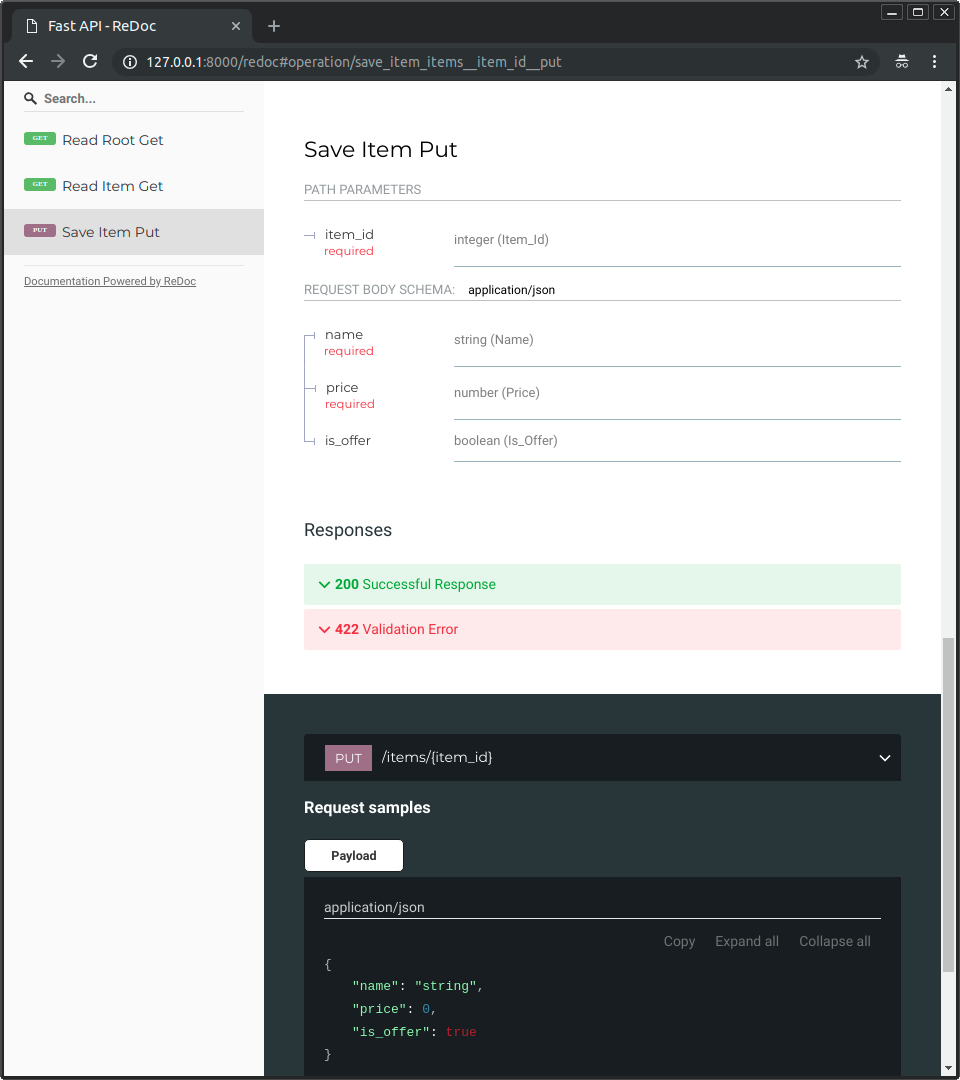
And now, go to [http://127.0.0.1:8000/redoc](http://127.0.0.1:8000/redoc).
* The alternative documentation will also reflect the new query parameter and body:
### Recap { #recap }
In summary, you declare **once** the types of parameters, body, etc. as function parameters.
You do that with standard modern Python types.
You don't have to learn a new syntax, the methods or classes of a specific library, etc.
Just standard **Python**.
For example, for an `int`:
```Python
item_id: int
```
or for a more complex `Item` model:
```Python
item: Item
```
...and with that single declaration you get:
* Editor support, including:
* Completion.
* Type checks.
* Validation of data:
* Automatic and clear errors when the data is invalid.
* Validation even for deeply nested JSON objects.
* Conversion of input data: coming from the network to Python data and types. Reading from:
* JSON.
* Path parameters.
* Query parameters.
* Cookies.
* Headers.
* Forms.
* Files.
* Conversion of output data: converting from Python data and types to network data (as JSON):
* Convert Python types (`str`, `int`, `float`, `bool`, `list`, etc).
* `datetime` objects.
* `UUID` objects.
* Database models.
* ...and many more.
* Automatic interactive API documentation, including 2 alternative user interfaces:
* Swagger UI.
* ReDoc.
---
Coming back to the previous code example, **FastAPI** will:
* Validate that there is an `item_id` in the path for `GET` and `PUT` requests.
* Validate that the `item_id` is of type `int` for `GET` and `PUT` requests.
* If it is not, the client will see a useful, clear error.
* Check if there is an optional query parameter named `q` (as in `http://127.0.0.1:8000/items/foo?q=somequery`) for `GET` requests.
* As the `q` parameter is declared with `= None`, it is optional.
* Without the `None` it would be required (as is the body in the case with `PUT`).
* For `PUT` requests to `/items/{item_id}`, read the body as JSON:
* Check that it has a required attribute `name` that should be a `str`.
* Check that it has a required attribute `price` that has to be a `float`.
* Check that it has an optional attribute `is_offer`, that should be a `bool`, if present.
* All this would also work for deeply nested JSON objects.
* Convert from and to JSON automatically.
* Document everything with OpenAPI, that can be used by:
* Interactive documentation systems.
* Automatic client code generation systems, for many languages.
* Provide 2 interactive documentation web interfaces directly.
---
We just scratched the surface, but you already get the idea of how it all works.
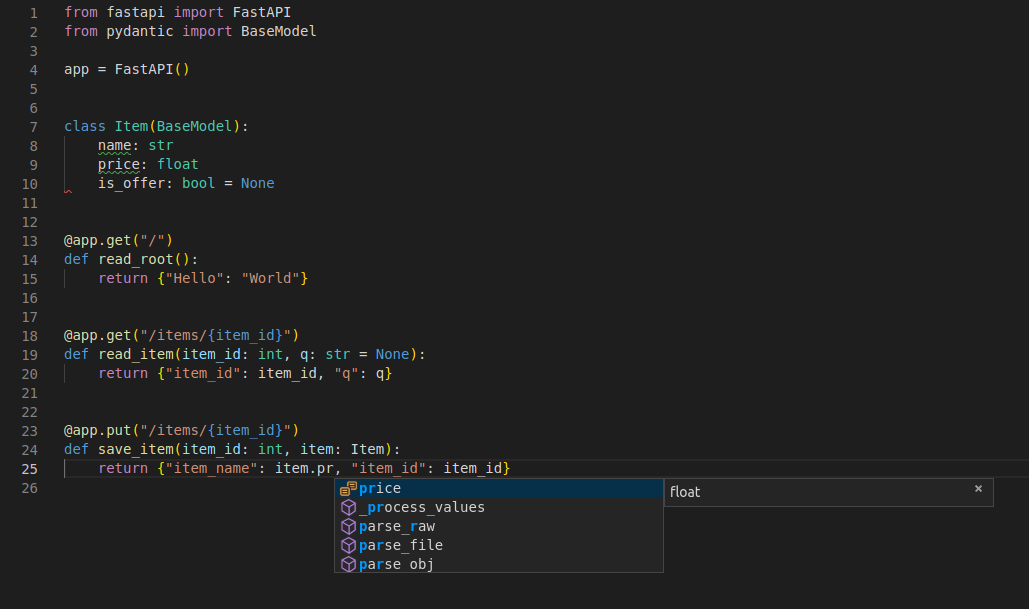
Try changing the line with:
```Python
return {"item_name": item.name, "item_id": item_id}
```
...from:
```Python
... "item_name": item.name ...
```
...to:
```Python
... "item_price": item.price ...
```
...and see how your editor will auto-complete the attributes and know their types:
For a more complete example including more features, see the Tutorial - User Guide.
**Spoiler alert**: the tutorial - user guide includes:
* Declaration of **parameters** from other different places as: **headers**, **cookies**, **form fields** and **files**.
* How to set **validation constraints** as `maximum_length` or `regex`.
* A very powerful and easy to use **Dependency Injection** system.
* Security and authentication, including support for **OAuth2** with **JWT tokens** and **HTTP Basic** auth.
* More advanced (but equally easy) techniques for declaring **deeply nested JSON models** (thanks to Pydantic).
* **GraphQL** integration with [Strawberry](https://strawberry.rocks) and other libraries.
* Many extra features (thanks to Starlette) as:
* **WebSockets**
* extremely easy tests based on HTTPX and `pytest`
* **CORS**
* **Cookie Sessions**
* ...and more.
### Deploy your app (optional) { #deploy-your-app-optional }
You can optionally deploy your FastAPI app to [FastAPI Cloud](https://fastapicloud.com), go and join the waiting list if you haven't. 🚀
If you already have a **FastAPI Cloud** account (we invited you from the waiting list 😉), you can deploy your application with one command.
```console
$ fastapi deploy
Deploying to FastAPI Cloud...
✅ Deployment successful!
🐔 Ready the chicken! Your app is ready at https://myapp.fastapicloud.dev
```
That's it! Now you can access your app at that URL. ✨
#### About FastAPI Cloud { #about-fastapi-cloud }
**[FastAPI Cloud](https://fastapicloud.com)** is built by the same author and team behind **FastAPI**.
It streamlines the process of **building**, **deploying**, and **accessing** an API with minimal effort.
It brings the same **developer experience** of building apps with FastAPI to **deploying** them to the cloud. 🎉
FastAPI Cloud is the primary sponsor and funding provider for the *FastAPI and friends* open source projects. ✨
#### Deploy to other cloud providers { #deploy-to-other-cloud-providers }
FastAPI is open source and based on standards. You can deploy FastAPI apps to any cloud provider you choose.
Follow your cloud provider's guides to deploy FastAPI apps with them. 🤓
## Performance { #performance }
Independent TechEmpower benchmarks show **FastAPI** applications running under Uvicorn as [one of the fastest Python frameworks available](https://www.techempower.com/benchmarks/#section=test&runid=7464e520-0dc2-473d-bd34-dbdfd7e85911&hw=ph&test=query&l=zijzen-7), only below Starlette and Uvicorn themselves (used internally by FastAPI). (*)
To understand more about it, see the section [Benchmarks](https://fastapi.tiangolo.com/benchmarks/).
## Dependencies { #dependencies }
FastAPI depends on Pydantic and Starlette.
### `standard` Dependencies { #standard-dependencies }
When you install FastAPI with `pip install "fastapi[standard]"` it comes with the `standard` group of optional dependencies:
Used by Pydantic:
* [`email-validator`](https://github.com/JoshData/python-email-validator) - for email validation.
Used by Starlette:
* [`httpx`](https://www.python-httpx.org) - Required if you want to use the `TestClient`.
* [`jinja2`](https://jinja.palletsprojects.com) - Required if you want to use the default template configuration.
* [`python-multipart`](https://github.com/Kludex/python-multipart) - Required if you want to support form "parsing", with `request.form()`.
Used by FastAPI:
* [`uvicorn`](https://www.uvicorn.dev) - for the server that loads and serves your application. This includes `uvicorn[standard]`, which includes some dependencies (e.g. `uvloop`) needed for high performance serving.
* `fastapi-cli[standard]` - to provide the `fastapi` command.
* This includes `fastapi-cloud-cli`, which allows you to deploy your FastAPI application to [FastAPI Cloud](https://fastapicloud.com).
### Without `standard` Dependencies { #without-standard-dependencies }
If you don't want to include the `standard` optional dependencies, you can install with `pip install fastapi` instead of `pip install "fastapi[standard]"`.
### Without `fastapi-cloud-cli` { #without-fastapi-cloud-cli }
If you want to install FastAPI with the standard dependencies but without the `fastapi-cloud-cli`, you can install with `pip install "fastapi[standard-no-fastapi-cloud-cli]"`.
### Additional Optional Dependencies { #additional-optional-dependencies }
There are some additional dependencies you might want to install.
Additional optional Pydantic dependencies:
* [`pydantic-settings`](https://docs.pydantic.dev/latest/usage/pydantic_settings/) - for settings management.
* [`pydantic-extra-types`](https://docs.pydantic.dev/latest/usage/types/extra_types/extra_types/) - for extra types to be used with Pydantic.
Additional optional FastAPI dependencies:
* [`orjson`](https://github.com/ijl/orjson) - Required if you want to use `ORJSONResponse`.
* [`ujson`](https://github.com/esnme/ultrajson) - Required if you want to use `UJSONResponse`.
## License { #license }
This project is licensed under the terms of the MIT license.